I caught up with John Q. Walker a bit on the break to ask him about where the Disklavier technology is going. John did the demo with the recreated performances that blew everyone in the conference away.
Vignettes: Paul Horowitz
December 3, 2007 – 1:24 pm
Lets’s compress the time between the sun forming and today into one “day.” Life formed around 05:20. The last hour, dinosaurs became exect at 11:39. In the last minute, neaderthals didn’t come until 11:59:58.1. Here’s the picture of the graph.

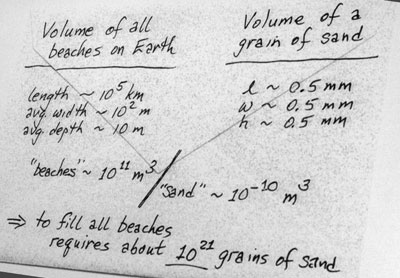
Paul said that when he tells people that there are more stars than grains of sand in all the beaches on earth, they go “yeah right” so he did some back of the envelope calculations:
Brian Greene
December 3, 2007 – 1:13 pm
In the decades that ended in the mid 1920s, Scientists did work that resulted in a fundamental understanding of the world like we never could have before.
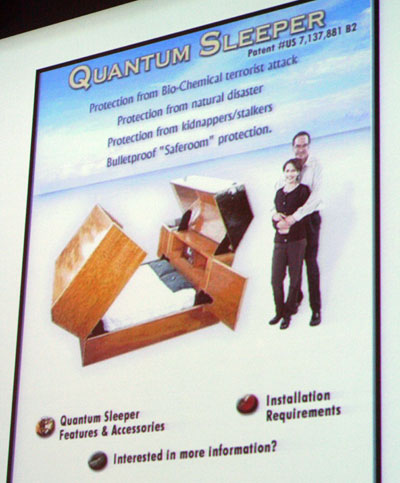
The contributions of quantum mechanics stand on their own. People don’t understand the basics of quantum mechanics. He showed some examples of “quantum” being misused. He’s going to try and give us the basics of quantum physics.
Here’s how it goes: quantum mechanics is based upon one concept and one imaginative leap. The concept is waves, how they move and interact. Whenever you see data that looks like bright band, dark band, an interference pattern, it tells you that you’re dealing with a wave phenomenon. If you have a bb machine gun and fine it a two slits, the BBs stick in two lines aligned with the two silts. If you fire electrons through the same wall, you see a wave pattern. What does that mean?
There must be some sort of wave associated with particles. But waves of what? These are individual pellets, where could the wave idea come into the story. Here’s the imaginitive leap, mid 1920s, people are struggling with this data. The wave associated with a particle must be a wave of probability. We are used to a reality where things are definite. You can predict what will happen. This introduction into probability into the laws of physics, is a radical departure from any way of thinking about physics or reality.
Why is it so unfamiliar if underlying everything is a probabilistic under bearing to everything around us. For a large object there is a spiky probability curve, you’re 99.999% certain the ball will follow Newton’s law. If you measure an electron you have a spiky probability wave, but an instant after that the location it goes to just becomes a much flatter set of probabilities, until you measure it again.
Every particle in a world has something called spin. Einstein found a “spooky” action, you could measure a particle and if it’s spinning up its mirror particle that could be thousands of miles away the other one will spin down at exactly that moment. A non-local interaction between distant objects.
Quantum computing, people are trying very hard to make use of the spread out nature of quantum mechanics. One particle to do many calculations at the same time. Final thing, if you think that any of this stuff feels esoteric, bear in mind, your personal computer, your cell phone, everything you see around us is based on the integrated circuit, which you wouldn’t have without quantum mechanics. Not only does this change our understanding of the nature of reality.
Vignette: Miguel Angel Corzo and Ryan McCullough
December 3, 2007 – 12:59 pm

Right before the performance of Ryan MacEvoy McCullough.
John Q. Walker
December 3, 2007 – 10:35 am
 The dream of listeners everywhere is to be there for a live performance, it’s the ultimate experience . Zenph Studios wants to separate performance and recording. He’s about to play the 1955 version live. They digitize 70+ factors of every note. The Yamaha Disklavier piano just performed Gordon Gould performing two of the Goldberg Variations. It was amazing.
Step by step, music will be turned into data. Audio came very late because our ears are so hard to fool. Not bits, but the data behind how the music was created.
The future is: Music = data + algorithims.
Right now recordings are frozen. In the future it’s going to be user controlled, you can break down music into the data and suit it to your personal moods and tastes. The elements of the music become like building blocks, a buffet where you can pick and choose what you like.
Now doing an Art Tatum recording. Will be a re-release of his album Piano Starts Here. Another great recreated performance. (I want one!)
Don Katz
December 3, 2007 – 10:34 am
Was a writer for 20 years, and a business guy for 12. CEO of Audible.com. We rarely find time to talk about what the new technology nad media culture actually means. Media is the sum of discruptive inventions that have changed the status quo. Audible continues the oral tradition that predated books. The paperback book was fought off for 25 years.
The movie industry said it wanted to stop two things: the video recorder, and cable and paid TV. He was at Rolling Stone when they saw MTV form around them. They weren’t able to make the transitions. Cable took 15 years, DVDs took 6 to reach 85% of homes. It’s going to be similar to the political and social disruptions of the late 60s. You are what happens to you at a particular point in time. I went to the Rolling Stone magazine reunion of everyone who worked there in the first 10 years. He was struck by how lucky he was to be young in those years. I knew everyone who was a professional non-fiction storyteller who had a house, it was a difficult business.
The second event that touched me was the death of Normal Mailer. He was a writer with a capital W. He did a piece called “Why are we at war?” which was an early attack on Iraq. He’s accused of not being a patriot. He lives in a nation that affords him time to think, and time to write, and that’s the best thing in the world.
Part of the reason he stopped writing was people just didn’t have enough time to read. He hears it from renowned intellectuals, even last night. A WSJ were stressed out by their lack of time than for their lack of money. He had taking an advance from Random House to do a “you are there” type of story about the digital revolution, but he couldn’t find what to right about. He discovered how compressible the spoken word was as opposed to other types of media. 93 million American works drove to work alone. What if that time could be filled with spoken words? I also loved the oral culture, wasn’t one of those writers who tried to separate them.
In the beginning attacked him in the literary cultures, he was not only abandoning writing, he was abandoning text. The substance what matters, how it gets into people’s heads shouldn’t be a religious issue.
Since starting the company, I only get time to think on airplanes. Spend more time with people whose tombstones will read “I provide liquidity.” He worries about the way culture is going, reaction videos. I got myself in trouble with the early podcasting community because he said Audible was excited because it would provide a farm club for them to cherry-pick great talent. Because if you want to have a job being creative someone has to pay you: the consumer, the advertiser, or a patron. People with less time on their hands than the early podcasters would decide that. He was called the “Bill Gates of digital audio.”
Brewster Kahle
December 3, 2007 – 9:55 am
 “If you’re going to give an upbeat technological talk, don’t come after Andrew Keen.”
We need to put the best we have to offer within reach of our children. If we don’t do that we’re going to get the generation we deserve. I grew up in a television generation, the closest I could get to TV was knowing someone who was in the Wonderama audience once. I remember the first feeling of participation was in cryptographer class and the professor said here are some problems, and if you have any trouble here’s my home number.
What did the Getty carve in stone? It was the hand prints of the people who helped build this place. In the garden: “Ever present never twice the same, ever changing, never less than whole.” Carved in stone at the Boston Public Library: “Free to All.” We have the opportunity to one-up the Greeks, they were able to build the Library of Alexandria. Universal Access to All Knowledge is within our grasp.
Books. The largest print library is the Library of Congress, 26 million volumes. About 26 terabytes of data. That storage would cost about $60,000, so for the cost of a parking space in LA you could have the entire library of Congress spinning on Linux disks. There are different ways for reading books online: PDF, booklike formats.
Brewster likes the physical book. They made a BookMobile, with a satellite dish, and it downloads, prints, and bind a book. It costs about 3 dollars per book. He wants to put books back in your hand. There are some other bookmobiles. If we can make this technology work in rural Uganda, they’d have something. They got some funding from World Bank, and it worked! What we found out was that we didn’t have the right books.
We have a print-on-demand machine, the Expresso book machine. He’s excited about the $100 laptop. 200 dpi is enough that you can put scanned books in there and they look pretty good. They sent 100,00 books to India with people and scanners. If you care about your books — scan your own. Especially if they’re old or fragile. They picked the price point of 10 cents a page, if it’s the same cost as Xeroxing, you can change the game. If we have mars rovers, you think you could turn pages, but it’s really hard.
They now do people-powered page turning and colleges. To do the entire LoC it would be about 750 million dollars, but a million books would be about a 30 million dollars, which isn’t undoable. The Getty is moving their books to UCLA and scanning their out-of-copyright books. They’re looking for funding to get the progress going. They’ve scanned about 200,000, they’re doing about 15,000 books a month. They’re moving from out-of-copyright, to the out-of-print world. He hopes they can meet Amazon in the middle between in-print and out-of-print.
Books are within our grasp, we can take it all on without that big a deal. One-time shot and we have the history of printed literature. We can get the whole darn thing.
How about Audio? There are about 2-3 million discs published, it costs about 10 dollars a piece to take a disc and put it online. But the rights issues are pretty thorny. Unlimited storage, unlimited bandwidth, forever, for free. The rock and rollers had a tradition of sharing as long as no one made any money. They get 2-3 bands a day signing up, 40-50 concerts a day. Everything the Grateful Dead ever did. 200,000 audio items so far.
Moving Images. There’s about 150,000-200,000 theatrical releases ever, about half were Indian! There are only about a thousand that are out of copyright. There are lots of movies that have never seen the light of day.
TV is harder. They’re recording 20 channels, 24 hours a day. They only put one week up, the 9/11 week. Television is dreadfully unrecorded and unquotable. TV is in our grasp, $15 per video hour. About 100,000 videos online.
Software, only about 50,000 titles available.
We’re best known for the WWW. We’ve been archiving the web since 1996, pioneered by Alexa which donates this collection to the Internet Archive. We make a Wayback Machine that shows you websites the way they were.
One thing to learn from the Library of Alexandria — burning! They’re now making multiple copies, one at the new Library of Alexandra. A copy in Amsterdam. What’s the role of public vs private goin forward. Is it proprietary. Universal access to all knowledge could be one of our greatest achievements of mankind.
Carved above the Carnegie Library, “Free to the People.”
Excellent talk!
Andrew Keen
December 3, 2007 – 9:29 am
For me, media is about the distribution of high quality information and entertainment. It’s about the exchange of money for that entertainment. That’s the media economy. He thinks the media economy is in “deep sh**.” Recently Radiohead tried to figure out a new business model for online, they should allow people to set their own price. 65-70% of people “stole” Radiohead’s music and didn’t pay anything. (I thought that figure was debunked?)
If I’m the anti-christ of Silicon Valley, who are the Christ figures? I won’t name names, but some have beards and some are here. Something has profoundly changed in media, what has changed is technology. Technology has enabled all of us to become authors, to distribute our content online, to become broadcasters.
Medias is being presented as liberating human beings, of making the world a more moral place. Just as Christ was trying to make man moral, the technology media evangelists are trying to make media into the engine of profoundly good social change. Last week I had a debate with Charlie Ledbetter. He said the internet and the digital revolution was good because we will become more equal, liberate ourselves, nad create better community. The premise is that we will all become more creative, our ability to become Hitchcock.
These are not business ideas, they’re moral ideas. They’re about liberation of self. It’s rooted in libertarian culture. Today’s internet reflects a climax in the way in which these libertarian idealists want to change the world. In the world this means the blogosphere, in Second Life. Priests invented a concept of heaven, but never figured out how to monetize it. The Second Life guys did. Anyone can create or recreate themselves online. The internet is a digital form of Christianity, we can reinvent ourselves independent from the physical world.
We’re using the internet to self-broadcast ourselves, as a battering ram against authority. Professionals aren’t born, they’re simply people that are more practiced and disciplined. The internet is trying to turn traditional media was never fair. It’s about finding talent, polishing talent, distributing, and selling that talent. You’re telling 95% of people that they’re not worthy. The internet tells us we’re all equal in our ability to distribute our ideas.
Some people say that’s the essence of democracy, it’s a “Christian democracy” and it’s not an idea he’s keen on. Real media, with concrete product, that is in big trouble, because the only company making money in this new economy are the vehicles of this self-made content. The traditional carriers of content, the carriers that selected talent, that published it and distributed it, are in great crisis. Music, newspaper business. The future of the media biz is dire. We need to reestablish the credibility of authority. We can’t be seduced by the cult of the amateur, the cult of the ignorant. We need to maintain the professional standards of media, remind the public that the traditional media ecosystem of fact checkers et al are essential to democracy.
If we do away with the credibility of newspapers, of books, then we have a true crisis because no one will know what happens in the world. For every Judy Miller there are thousands of honest reporters. We cannot back down in this populist rebellion, if we do then we’re going to regret it. We’ll only have Youtube, one long advertisement, where it’s increasingly difficult to distinguish between advertisement and content. The blogosphere is a device for dishonest people to hide behind websites and organizations to peddle their message.
We need to address this crisis before it’s too late, otherwise the Youtube generation are going to know nothing, and it will make them bad citizens. And it will impoverish political and moral life in this country.
Jim Citrin
December 3, 2007 – 9:11 am
 Jim is a executive headhunter. Last night at dinner someone stopped him to talk about enhanced metadata and standards, she thought he did a different kind of “search.” He’s asking a series of questions:
Where are you in your career? first quarter, second quarter, third quarter, fourh courter, retired
How do you assess yourself in your profession? Intermediate, high performer, expert, world class.
Rate your focus, 100 points: __ To excel and achieve personal success + __ to make others around you sucessful.
Three quick words that provide true meaning in your life?
Have you found your life’s calling? Not looking, still looking, found it
If you’ve found your life’s calling, what impact could it ultimately achieve. Meaningful at the individual level, important at the local level,
How close are you to realizing this potential? Just starting to make a dent, a quarter there, half way there, just about there
He’s been exploring success at the CEo level for 14 years. He’s written a number of books. He did a lot of research, talked to 50 notable people from Bono to Tiger Woods, he wanted to figure out what are the elements of success.
There is almost no exception to the 10 year rule, that you can’t become world-class in a field in fewer than 10 years. The break point is hours of practice, but not just number of hours, but how directed and deliberate the practice is.
Michael Jordan vs Bill Bradley. Juxtapositions. MJ – no one had greater natural talent, no one worked harder, etc. The question is, what has he done with his resources since he retired? He’s lost a big opportunity to have an impact. Bill Bradley, the entire time he was at the Knicks he was laying the foundation
Jack Nicklaus vs Tiger Woods. Tiger uses golf as a means to an end, he wants to have a bigger impact. Mick Jagger vs Bono. Bjorn Borg vs Billie Jean King. Noel Cunningham vs You. He came over as a normal guy, was a cook, eventually opened a restruant in Denver called Strings, called a foundation called Quarters for Kids, connects students in Denver to connect them with Ethiopian children in need.
Assignment – reflect on your answers to the 7 initial questions. Write one paragraph – 10 years from now.
Rob Glaser
December 3, 2007 – 8:48 am
He’s going to talk about something outside of work, Real Networks. A joint effort of the Glaser Progress Foundation and the Center for American Progress.
They want to treat “progressive” like a brand that is nutured and managed, just like any other brand. They want to educate Americans about what it means to be a progressive.
He wants to change the political paradigm in America to Liberal/Conservative to Progressive/Conservative, and create a durable progressive majority.
Several phases, first learned what Americans think about Progressive. Create some test ads and run them. Then shared all the data. Finally scale it up.
They found the Liberal brand is quite tarnished, but Progressive isn’t as well known. They felt there was a huge opportunity to educate Americans on the meaning of progressive. They tried 30 second TV ads as an education vehicle, used Zimmerman Markman Agency, and ran them in Columbus, Indianapolis, and Milwaukee. Did focus groups, 15 scripts, shot 8 concepts, showed them to online focus groups, picked the 3 winning campaigns, and ran one in each market. This was all about a month ago.
He’s showing the commercials, which are available on Youtube.
The early resultss were favorable, it increased progressive self identification, they were regarded more favorably. They spent 500k over 3 weeks in Indianapolis. They ran a lot, 90% of the population saw the ad 5x a week, recall was 11-23%, which is low. Two reasons: it came out of the blue, no context, and the Tivo effect.
They put the ads on the internet about 2 weeks ago, have been viewed over 500,000 times. MoveOn did a vote on which their users would like to see more of, and the Mac/PC spoof got fewer votes than Pro/Con video. MoveOn is going to run the winning ad nationally on CNN.


 The Entertainment Gathering