Ian Dunbar – Dogs

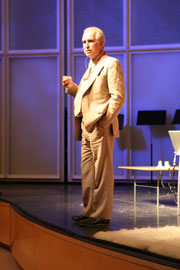
Ian Dunbar Dogs have interest. They try to harness the distractions that dogs naturally have. You can’t compete with the dog’s natural views, “rear end vs owner.” You train a dog by making up rules, human rules, we don’t take the dog’s rules into account. We keep these rules a secret from the dog. Then we punish the dog from breaking the rules he didn’t know about in the first place. When dogs are puppies they’re trained to do things like jump up on your leg and you pet him and reward him, a year later when he’s huge he gets punished for jumping up the same way. It’s scare the abuse and mixed messages that dogs get.

He’s showing some videos of very well-trained dogs. The dog books tell you when a dog jumps up you whack them with newspaper, squirt them with lemon juice, all types of abuse. The first stage in training is to teach the dog ESL, because they don’t know what you’re saying. The second stage is training is to make the dog want to do what you want it to do. They mix low-frequency behavior with a high-frequency behavior, like “sit, rub belly. sit, fetch ball. sit, food.” They motivate the dog to want to do it, the need for punishment seldom comes up. Phase three, there’s times when you know best, you have to let the dog know about things they must not do, like run outside the house where they could get hit. They have to enforce the rules without the force. A punishment is a stimulus right after an action that encourages that action not to happen again. You can calmly talk to them.

I have friends who train grizzly bears, how are you going to reprimand a grizzly bear? You don’t, it’s a different approach.

If you go to the Lincoln Memorial and look at the Gettysburg address chiseled in the right, and the word “future” is a typo. It’s spelled “uture.” (Huh.)

It’s about relationship skills. Some people take delight in people getting things wrong so we can moan and groan at them. These skills should be taught to everybody. Where I want to do with this doggy stuff is “You know, your husband is really to change.” Just saying “thank you” is so powerful. This should be taught in schools. Good habits are just as hard to break as bad habits. 75 million dogs in the US, 45 million families

Caleb Chung – Pleo

Caleb Chung Giving Toys is his company. Used to work at Mattel. He did a lot of toys, most did not go, 1 out of 20 or 30 would go live. Showing a lot of funny demos of various toys that didn’t go, like the flame-throwing tail. Did the McDonald’s cooking toys, which did about 50mm. Eventually left LA and moved to Idaho. Throughout making toys I think there’s a real correlation between art and science, there’s a blend that happens. He was the co-invertor of the Furby, and is about to show a video about its tale.

He was fascinated with film and animatronics. Little artificial life pieces. He worked on Microsoft Barney, it was like a purple dinosaur with bloatware. They decided to make the simplest thing possible with the fewest parts possible and have a little artificial art/life form. He’s going through a slideshow with all of the steps along the way to creating Furby. They would would sneak into HP on the weekends. A friend of a friend worked at the SLA lab at GM. 40 million Furbys (Furbies?) were sold.

Pleo Evolution. Kind of retired, living in Boise on a river, started another company call Toy Innovation. Did a handheld device for teens that hooked up to the internet. Slowed down. Had the old tape of the dinasaur, some other people saw it. They began to try to clone a dinasaur. Picked a Camarasrus because they were so plentiful. The first SLA version they had a cuteness in the dinosaur, the servos had to be shaped like muscles, had a real dedication to be accurate. Hardest part is the skin. 4 years and 10 million dollars later, they now have the Pleo. A very realistic dinosaur that goes through life stages and you can take care of it, they change over item, you take care of them.

It has an open architecture, a USB port and a SD card. You can hack the underlying code to change its homeostatic drives, its personality. There will be drag and drop features for kids.

Pleo

Pablos Holman – Bump Key Demo

During his presentation Pablos demonstrated a bump key, which is a trick to bump a specially crafted key in most locks and it will open it. One of my trading cards was actually getting one from him, and when I tracked him down he gave me a short demo for the camera:

Monday Night Dinner

The dinner tonight was really great. I tried to write down the restruants that were present, here they are:

Gelata, a southern Thai restrauant. Burmese cooking of Golden Triangle. Cambodian dishes from Sophie’s in Long Beach. Soul food called Larkin’s. Harold and Bell’s part of large Creole community in LA.

Getty at night

Ken Knowlton – Mosaics

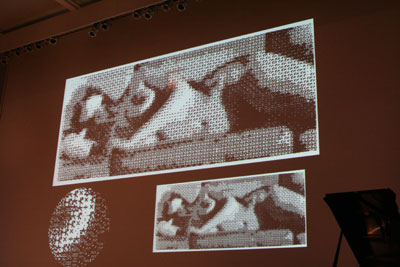
He was initially fascinated with technology as a result of the 1939 World’s Fair in New York. He started in a one-room school, then a 80 person-class high school, cornell, then MIT where he was introduced to computers. He authored the first computer programming language for raster movies. “Seen as the founder of computer film in America.” Within 3 years I got into a project that’s been called the most known he did, even today, Harmon-Knowlton Nude. Basically ASCII-art nude woman lying down, fairly abstract. Now he creates art out of objects, all mosaics, quite striking. I’ve got some pictures below, try to look at them close up and then back away. (I think it’s a better experience in real life.)

Knowlton Nude

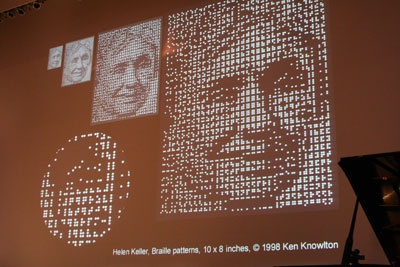
This is a portrait of Hellen Keller made out of visual braille:

Hellen Keller

His website is Knowlton Mosaics and he has a wikipedia page.

Brewster Kahle on How to Help

I asked Brewster Kahle how people could help out the fine work he spoke about earlier.

Angelin Chang

A classical pianist and music professor. LA is a special place to my family, because my older brother, Angelo, was born here. Next in line, Angelin, Angelina, and Angel. Anybody know what a “hoosier” is? It originated when there was a knock on the door and people in Indiana would say “who’s there? (hoos-ierrrr?)” She’s trying to connect classical music to a new audience, she’s a big fan of the Disklavier piano. She did a performance where they hooked up the MIDI output to have live graphics triggered by her hitting the keys performing a Liszt piece. She’s now doing a Bach piece that demonstrates this.

You can see her website and buy her CD at angelinchang.com.

Angelin Chang

Chef Ann Cooper

She wants to change the type of food in school. Teach them the relationship between healthy planet, healthy food, nad healthy kids. We got here because of big agribusiness. Monsanto and DupPont control 90% of the commercially produced seeds. Average food travels 1,500 miles before we eat it. No food with frequent flyer miles. Most school districts can’t afford organic food, but we can’t keep feeding our children chemicals. 70% of all antibiotics is in animal husbandry. The majority is for weight gain. 75% of the antibiotics in the country have become ineffective. US agriculture uses 1.2 billion of pesticides each year, 5lbs for every American. The USDA can not be seen as the final say in what we feed our kids. The point of all of this is sustainable food.

We now have more prisoners than farmers. Unhealthy eating can lead to lot of bad things. She just put a picture of a coffin and tombstone on the screen. 40% of cancer is diet related. 80% of cancer can be prevented through ealthful diet and exercise. CDC has said that children born in 2000 could be the first generation in a long time that lives a shorter time than their parents. Cheap corn and keep soy promote this bad types of food and allow fast food to be so cheap. We need to teach our kids that vegtables are actually colorful and have flavor. In Berkeley they’ve gone totally local farm, no high fructose syrups, etc. Scratch cooking is the center of their program.

1 out of every four meals is fast food, 1 out of four is eaten in front of a TV or computer. Instead of the national school lunch program being under the USDA it should be under the CDC.

Marvin Minsky

Going to talk about the dark side of cuteness. When I was a kid, the story of the three bears, Goldilocks. When I heard that story, I didn’t see anything wrong with bears that talked or made porridge, but I didn’t see any thermodynamic way which it could fit. Marvin has a book called The Emotion Machine. Soon we’ll need to endow our Machines with Commonsense, Knowledge, and Reasoning.

If you have an increase in life expectancy is going to cause a major labor crunch. No one will want to do the work.

He put “emotion” in the title of his most recent book to fool people into being interested, it’s actually about thinking. If you ask people what it’s like to be in love, they can write books and books, if you ask them how they just had a thought or idea, they haven’t the foggiest.

Old view on emotions: Most emotions add features to thoughts, the way an artist adds colors to black and white drawings. Those additions seem mysterious.

New view on emotions: Each emotion tends to SUPPRESS certain features of regular thinking. This does not add any mysteries!

Why did intelligence take so long to evolve? Just a few new genes would have made our brains larger, but this would have caused some grave handicaps. The human brain uses about 20 watts. What must have happened is before the brain could get larger it had to get some improvements in processing. Values, censors, ideals, taboos. There’s no evidence that any of the earlier mammals can think about what they’ve been thinking recently. It’s a few tricks like that, reflective thinking, that enabled us to use knowledge more efficiency.

What happened AI? There was a DARPA contest recently where a team with 100 miles in a computer-driven vehicle without hitting an obstacle or falling in a ditch. In other words, they can do what every four-legged animal can do. I’ve never seen anybody discuss what I call quantum certainty. Solar systems are not very stable, if something happened to change the orbit of Jupiter a little bit, it would effect the other planets. The planet Pluto is not stable, it will be thrown out of the solar system in about 3 billion years. In the quantum world, nothing ever changes except suddenly, and those changes only happen every few trillion years. The electrons around a hydrogen atom can only be in a certain number of orbits and the probability of being outside that orbit is zero. (That was a tangent and I might not have caught it all correctly, but it sounds like he pretty strongly disagrees with the earlier speakers.)

We developed new ways to think, and learned to hang around older people and learn new ways to think. Think of the brain as 400 little computers which has evolved to do a different thing, and each mental state is what you get when you turn on 50 or 60 or 10.

The critic-selector model of mind: When you fail to achieve a goal and if you can diagnose what went wrong, then you may know some way to change your approach. Analogy, change how you’re describing it, break it into parts, replace it with a simpler one, ask another person for help.

Keith Schwab

Keith Schwab Why do physicists “believe” these strange theories? Physics is based on experimental reality. “The test of all knowledge is experiment. Experiment is the sole judge of scientific truth.” Richard Feynman.

Phisics is based on experiment.

The nature of Reality is absurd.

We don’t know what QM means, but that it is highly testable without discrepancy.

(Sorry I missed most of this, it was very dense (in a good way) and almost impossible to transcribe, best bet would be we waiting for the official video.)