Jonathan Harris

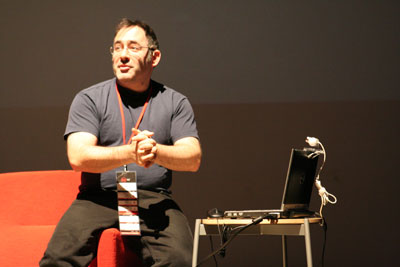
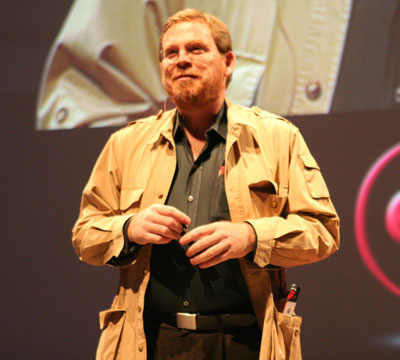
Jonathan Harris We Feel Fine – scans newly posted blog entries searching for occurances of “I feel” or “I’m feeling” and tries to determine some demographic info about them, like their age, location, what the weather is where they are. About 20,000 sentences a day get put into it.

He has some awesome visualizations for these, one with dots, one with the sentences in order, and this popped up on screen and Jonathan read it:

“I feel like changing to WordPress.”

Cool! 🙂

There’s a version with pictures attached to it, a statistical view that can break it down by weather, gender, gender, .

“I feel like I’m diagonally parked in a parallel universe.”

It collects short stories, sometimes as short as 2-3 words.

New projects, stories from life. The Whale Hunt – he lived in Alaska with some eskimos. The eskimos wait for a whale to pass, and then harpoon it, and then haul it up. He photographed the entire expience, beginning the taxi ride to the 2nd killed whale 7 days later. A camera took a picture every 5 minutes, but he could speed up the pace if something exciting was happening, like a photographic heartbeat.

Bhutan is a country where they focus on Gross National Happiness rather than Gross National Product. He would ask them to rate their happiness between 1-10 and then inflate and give them that number of balloons. Then he asked their wish, and then wrote it on a balloon, took a picture of their hands, a portrait, and then asked them to make a funny face. He’s going through about 10-20 of these mini-stories attached to the pictures, they’re really interesting.

He then took all of the wish balloons, re-inflated all the balloons and put them on a string. They’re still there.

Jonathan is at number27.org.

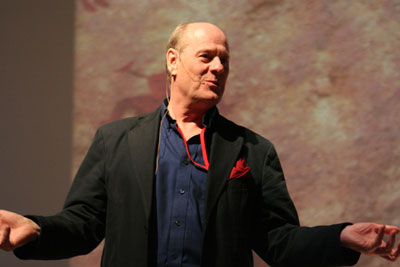
Jonathan Harris waving hands

Golan Levin

Golan Levin

Experiements at the Intersection of Art, Technology, and Nonverbal Communication.

Golan’s site is Flong.com. (I like that it rhymes.)

“From the perspective of a typical computer, a human is a brain with one finger. – Joy Mountford

So much of the life is conducted through the mouse. The mouse has to be the narrowest straw you try to suck all of human expression through.

The work he does, which manifests itself as art, also is experimentation that he hopes that will be incorporated into the future paradigms of computer.

Dialtones – There was a concert where they registered their mobile phone, and whether they wanted to be soprano, alto, tenor, or bass. They got back a ticket telling them where to sit and got SMSed a ringtone. On stage is people dialing the phones over and over to create a symphony. They would do chords by dialing multipl people at the same time. They’re create melodies that move throuh the crowd. 8,000 phone calls in the 20 minute concert.

Most of his work has to do with gesture and the body. To reflect things back to people so they can learn something about themselves that they didn’t know before. They did an exhibit where singers’ voice and location was an interface into an interactive art project.

He’s doing a live demo of some software called Eyecode that takes a picture of your eyes every time you blink, so the image is wholly constructed by the people who viewed it.

Opto-isolator is a machine which makes eye contact. Right now it looks you in the eye and it blinks when you blink. He wants to do the eye contact like on a train when you look at someone and it looks away, or it looks at the person who is talking.

Another project, called Facecode, when you look at it slices you face into three segments, and then splices it with other people who have also viewed it.

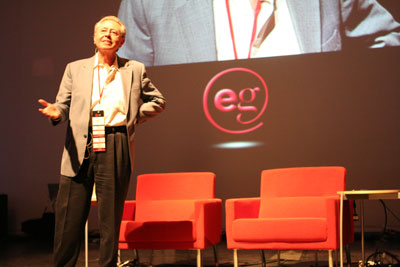
Jim Cox and Michael Fry

Jim Cox, Michael Fry

They showed some cartoons from RingTales.com, pretty funny.

Mike does a cartoon called Over the Hedge. It was the first he had seen that had an email address. He sent him an email and said “Can we make a movie?” The movie came out last year from Dreamworks, 10 years later. There must be an easier way to make animations out of cartoons, and bring it to the internet.

Comics have been mass-media for the past 100 years, but where they’re distributed is slowly dying. They want to take this art form to the new medium. They’re not trying to make movies or TV shows, just trying to animate the strip itself, 15-30 seconds. Print cartoons are always a casual part of reading, a “Zen slap in the face” that wakes up the other part of your brain. They want to have these little cartoons everywhere that people are reading things digitally.

They started with the New Yorker archives, they have over 100,000 comics. They have an open editorial session every TUesday, anyone can walk through the door and try to get published. They get 10,000-15,000 a week, and print 20. They try very hard to honor the art of the original cartoonists.

Computers don’t like all the imperfections that cartoonists put into things. They do most of their animation hand-drawn, it’s old-fashioned, but it captures the look and feel of the art. They had a license for the New Yorker stuff, and just finished a deal with United Media to their comics, doing Dilbert. They’re hoping it will become ubiquitous, while you’re reading, you’ll get a little gift of humor.

The site is RingTales.com.

Ken Librecht – The Secret Life of a Snowflake

Ken Librecht

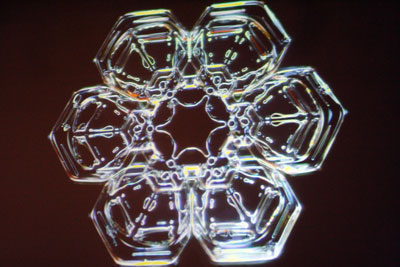
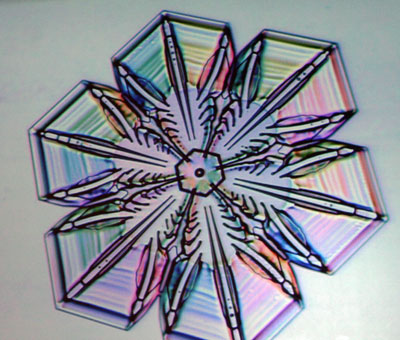
He does snowflake photograph, a camera attached to a microscope. He lives in Southern California, so he has to travel a bit. Northern Ontoria is his favorite. He lets snow fall on the cardboard, then looks for one that looks nice. He then picks it up with it up a paintbrush, and then put it on a microscope slide.

Snowflake

He’s going through pictures of snowflakes, apparently the different shapes all have names. He shines colored lights on them, because they’re clear. He photographed a 10mm snowflake, he thinks it’s the largest photographed.

Snowflake

His website is SnowCrystals.com.

Donald Jackson

Donald Jackson

Most museums wouldn’t think of inviting a living calligrapher, they only want the dead ones. He has two more years left on the bible he’s working on. He has spent his whole life doing something that most people don’t think that they want.

But people realyl do, when htey find something that they need to say in a different way. When you make something essentially for yourself, and then you put it out there, and it has an ability to connect in a way that type does not, no matter how bueatiful.

When he was watching the violinists earlier, he wasn’t watching the violins or the bows, he was watching the feet. That’s where the music starts.

Calligraphy can channel energy, it’s polite, it’s wedding invitations. Not many people come across it in your everyday life. Why would you have a wedding invitation written by hand? He said, it’s when you want to show someone you care about them. It’s about expressing a feeling. What does that say about our society that only on the level of wedding invitations that we employ that level.

He fell in love when he was little boy with calligraphy. He fell in love with a bottle of red ink, a pen point, and a pen. His aunt gave it to him in desperation to stop this kid from rampaging around the place. (Why did she think red ink was going to help the situation. ;))

You can have “cute” calligraphy, he draws a very loopy B on the board. It’s great for engraving, but you couldn’t read a bible in that type.

He wants everyone to make a letter in the air. Just like a violin, you can put a motion into a graphic art, and it stays there. Everyone just did the Reinassance A, it’s like typographic yoga.

If he was in the Middle East and was a Torah scribe, everyone would know his job, because he was dealing with the sacred. Same for the Koran. In the West, it’s actually something servants do, lawyer’s clerks do, notaries, except when it comes to cerimonial work. There are more people writing invitations at the White House than at Buckingham Palace… there are none at Buckingham Palace. You’re just happy enough to get the invitation! He’s showing some examples of the things he gets commissioned to do.

Behind, but still here

There is no downtime between sessions, but I’m trying to backfill pictures and entries in quiet moments in subsequent sessions, but everything is so fast-paced it’s more likely that more of the entries will go up during the break in about an hour.

Nathan Myhrvold – Why do we think things are cute?

Nathan Myhrvold While in the Falkland Islands he saw some birds and started wondering why we think things are cute or not. Human children have many features of cuteness.

  • Head large for body
  • Rounded features
  • Eyes too large for head
  • Long eye lashes
  • Wide set eyes
  • Dilated pupils
  • Small nose
  • Large hadnds with stubby fingers
  • Fuzzy or furry. Chubby Cheeks.

If you’ve ever had a child, they’re also impossibly annoying. If you didn’t think they were gosh-darned cute, they’d no longer be around. That’s not just true for humans, it’s true for mamels. He’s going through pictures demonstrating some of these characteristics. (I wonder if all these photographs are his? They’re great.)

I missed the name of the bird, but it’s definitely something that isn’t cute:

  • Small head
  • sharp features
  • beady eyes
  • no eye lashes
  • no cheeks
  • long neck

In short – snake with wings. They may be beautiful, but not cute. Even baby crocodiles aren’t cute, unlike many young in different species. They don’t have distorted features relative to the body, they’re just small versions of adult crocodiles.

It’s likely that we have a common conception of what’s cute because they have a common inheretence, something that was involved in the evolution of species that can’t support themselves when they’re young.

Most people are between 5-6 heads high. Shrek is 4 heads high. 4 heads high isn’t as extreme as a baby, which is 2.5-3 heads high, but Shrek has those proportions because he’s supposted to be lovable. We’re not supposted to love Prince Charming, and he’s 7 heads high. If you look at classic comic books, heroes are 8-9 heads high, they’re pinheads!

He’s showing 4 penguins from a movie. (He’s on the board of Dreamworks.) Knit brows, narrow set eyes – serious penguin. Open brows, wide set eyes, the goof. Even tigher brows, half closed eyes, narrow set, large nose, the boss./skipper. Open bros, very wide-set eyes — the clueless one.

He was on a safari and saw a lioness who had one eye that was enormously enlarged and blue. Most lions are right-handed. If you’re right-handed, you’re more likely to approach from the right side, and you’re more likely to be injured there.

He did a demo wiht modifying Dick Cheney’s face to make it cuter, I got a picture:

Cute Dick Cheney

“If I can get you to think, even for a second, that Dick Cheney might be a little cuter, it shows how strong those evolutionary biases are.”

We’re hard-wired with hundreds, maybe thousands of these built-in notions. Art and architecture try to figure some of that out, usually it’s more difficult because there’s nothing as obvious to compare to as that baby we saw in the beginning. If you come to EG in twenty years, there’s a real opportunity to learn more about how those things work, and inform the visual arts in a quantative way like we never have before.

Gran Tourismo

Miguel Angel Corzo

Miguel Angel Corzo is giving a background on the music here at the conference. All of the music is from students at his conservatory, the Colburn Institute.

He thought it’d be a good start to talk about one piece, called Gran Tourismo. In his view these conferences really are about a sense of discovery, a sense of looking around, taking a trip, going in different directions. It is tourism. Gran Tourism is the name giving to the cars racing around.

The piece wa by a living composer, a 28-year-old man here at the conference, Andrew Norman. He was inspired by three things: th sense of discovering futuristic art, the sense that there was an incredible opportunity to pick up on an Italian theme combined with a modern approach, and finally his roomate had a game called Gran Tourismo.

It is performed by 8 violinists from the Colburn school. The piece is a race, everyone is trying to beat everyone else. It has a complete sense of perfection in that everybody has to follow everbody else — it is performed without a conductor. Everyone has to be listening to each other. At the very end when you think it’s finished, it picks back up again.

Violinists

Kevin Kelly and Eduardo Santana

Eduardo Santana and Kevin Kelly

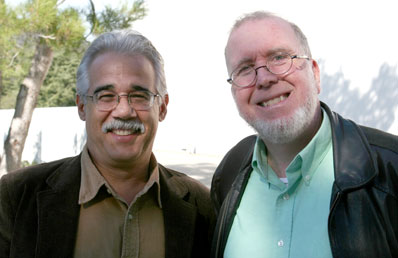
Eduardo Santana on the left is from Guadalajara, he’s a biologist (with a penchant for birds) and he’s currently working on creating a new natural science museum. He’s here to gain perspective to help him shape the museum, which they hope to launch in 2011.

Kevin Kelly is a speaker at EG. He has a incredibly short domain name, kk.org, and here’s his Wikipedia page.

Different Strokes Cheatsheat

Michael Hawley

The first session today is going to be called “Different Strokes.” You can of course read the bios of all the presenters, but here are a few links and recent news about each that hopefully give a little more background.