Vignette: Monday Morning

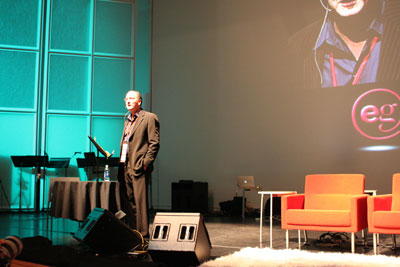
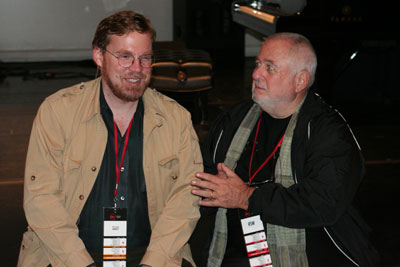
Had a little trouble with the shuttles this morning, which got myself and about 5 other folks this morning a few minutes late this morning. However I did snap a picture of Louis DeMattei, Amy Tan, and a charming lady whose name I missed. (If you can help out leave a comment.)

Waiting

Here’s Michael introducing the day.

Getty Room

Sunday Done

Emptying auditorium

Sunday is now all wrapped up, what a whirlwind first day. Met some great people at dinner. (Saw Jeff Bezos in the crowd and at dinner.) Going to try to rest up so I can do my best to keep up tomorrow.

Adam Savage

The Mythbuster guy! He’s doing a Q&A with himself, hopping from chair to chair.

Adam Savage

He says he’s been thinking a lot about Open Source, he’s been trying to think of what’s next. He sees an amazing thing happening with Make, Craft, Intsructables, Lifehacker, people are trying not only to parse their world, but take it apart. Someone always takes the hit to buy a brand new part and take it apart to its base parts. He started to look at analogs for that, and he looked at the car. He thinks we’re still in the Model A period of the computer, even though they’re ubiqutous, they’re still a lot of work.

You have post-war America, you have people with some leisure time, rising middle class, so you had these cars that were great but they didn’t work as well. When people started working on their car they started making improvements. Industry started taking these improvements and incorporating them. That’s what happened in the 50s, and that’s what’s happening now. Endless websites devoted to modifying technology to fit your life better.

Because of this massive community that is the web, you can connect from across the world. It’s a trope to say the web is a great community, to me it’s not the source of all knowledge, it’s a repository of discovery. I always knew the web was a great idea, I just hadn’t figured out what that idea was yet. There’s a desire to learn, the web is providing that to a huge capacity.

When I first moved to New York I got addicted to dawn, so I slept like every third day. He stumbled upon Canal street when all these stores were opening, sounds like lots of parts stores. The web is like that on steroids. The show is inspiring a generation of schoolkids. There’s a sense of wonder in what we do, a sense of curiosity. There’s so much great, great stuff that it’s like a… in the 70s everyone started knitting, home crafts, my Dad made glasses from old wine bottles with this kit he bought, we’re having a resurgence of that. We have a hacker culture… hacker comes out of MIT in the 50s, the idea is a do-no-harm exploration of the world. We declared the American frontier completely explored in 1909, there’s a new frontier, like the duct system at your college.

In the last five years, the hackers have met the knitters. They’re generating knitting machines that make Nintendo knits and stuff.

What do you plan to do after Mythbusters?

The idea of Open Source, to call this exchange OS is to do a chicken and egg reversal. Science has always been open source, you do research, you figure something out, and you publish! Hopefully you don’t waste your thesis on something somebody did already in Germany. Open source is that exchange of ideas. When I think about what I’d like to do next, I posit a show that is an interface between TV, the web, to interface between what goes on the show and the audience, to develop really great ideas and build upon them, and those ideas are in the public domain. Whatever we do I’d like it to be an interaction with the audience, I’d like it to be free to the world, and I’d like to be able to improve ideas over time.

My knowledge is for everybody. It’s not like other professions when you ask someone how they did something and they won’t tell you.

Keith Black

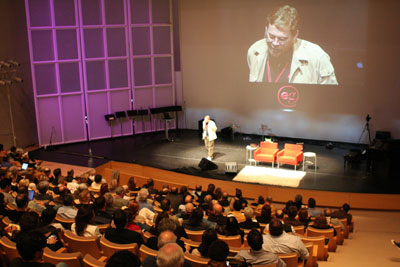
Performs 200-300 neurosurgeries a year. He’s a surgeon. He’s dona bout 7,000 operations for brain tumors. He’s also a researcher to try and find better treatments for patients with disorders in the brain. 99% of the procedures that we practice today started in his lifetime. It started with Egyptians, recorded how to relocate a shoulder, figured out that language mapped to the left side of the brain. If you went to a doctor in the 1940s he was more likely to do you harm than good.

When he grew up he was a fan of Star Trek, there was one episode when the Enterprise came back to the 20th century. Showed a clip that shows Bones arguing with a 20th century doctor, calling him a barbarian for wanting to drill a hole in the patients head to find the cause of the pulse slowing.

Most promising development in the past 10 years is stem cells. What isn’t really discussed is the problem of trying to use embryonic stem cells in the treatment of humans. They’re from a person, so they are rejected by the new patient. The other big problem why they won’t be used in the next 5-10 years is that the cells are immortal, meaning they keep dividing and dividing, which is the same characteristics of cancer. They can cause cancer. (I hadn’t heard of this?)

We had an ‘aha’ moment when looking at learning at behaviour in two sets of rats. One set was put in a regular cage, the other rats were put in a cage with mazes and other engaging things. They found the rats in the fancy cage had more neurons and more connections between them. The first thing that changed in the brain was the immune cells in the brain, and it was the immune cells that then called the natural stem cells to the areas of learning and made new neurons. Our immune system is guiding the stem cells. The immune system is directing our ability to learn, and our ability to create new memories. It gives us the ability to use the immune system to direct stem cells in the brain without ever taking them out of the brain.

Patients with immune disorders, like the bubble baby, also had learning disorders. There’s a rat line where they can immunize and reverse Alzheimer’s disease in these rats. If you give Alzheimer rats a vaccine that can activate a particular immune cell in the rain, it can reverse the disease. The same thing could also occur in rats in strokes. Their ability to intervene clinically in a stroke is only good for 3-6 hours after a stroke, if you don’t get there in time, you miss the opportunity for any therapeutic treatment. But using these immune-directed stem cells they can actually regenerate.

They hope to do clinical trials for these brain-based vaccines within the next 18-24 months. (!) In the most aggressive form of brain cancer, they can stimulate the immune system to attack tumors. They increased the two-year survival rate from 8% to 42%.

Liz Diller

Architecture fundamentally challenges the assumptions and conventions of space. She’s gathered a sample of work that demonstrates “productive Nihilism.” High defitinion has become the new othedoxy. They created an exhibition space which was a cloud, like fog. Fog pyramids, about 300 feet wide, sits on 4 delicate columns. The system is reading the real weather. All references are erased, nothing but whiteness and white noise. It’s an anti-spectecle.

They have a water bar, where all the waters of the world are served. It was adopted as a national icon that came to represent Swiss Doubt. It was a temporary structure that was eventually destroyed. It’s a memory of an apparition. It lives on as a chocolate bar. In the 80s and 90s they were mostly known by independent work, comissioned work from museums. The work itself resisted the nature of a retrospective. The retrospective is an invention of a museum that’s supposed to represent a complete body of work, but their work resisted that because it doesn’t resolve itself.

They created a robotic drill that went around and drilled the wall, as the wall represented a museum construct. The drill would pick a random point on a wall. Rather than be a backdrop, the wall competed for attention, eventually destroying the acoustic and visual seperation, and removing all the curator’s text.

They’re redoing Tully Hall to remove al the visual distractions. The walls will glow at certain times in the theatre experience.

Peter Gelb

General manager of the Metropolitan Opera in New York. They have an annual budget of 250-260mm a year. He worked there as an usher when he was young. He has no formal musical training, but he’s now running the world’s biggest opera house. It’s interesting to be juxtapositioned with Liz because she’s transforming Lincoln Center from an architectural perspective, and he’s transforming the Met from an artistic perspective.

Peter Gelb

He just began his second season as a GM. He was most recently the president of Sony Classical, he was more famous for the crossover hits, like the soundtrack to Titanic — the anti-christ of classical music. The Titanic soundtrack sold 28 million copies, best selling pop album ever. The environment of the Met was at a point where ever since the events of 9/11 its attendence was steeply declining and its audience was aging.

The board declined to tell him just had bad thing were. There was a marketing survey that showed that the average age of the audience was 65 years old, the bad news was that 5 years older it had been 60 years old. The government doesn’t support the arts directly, but through tax breaks for donors to non-profits. The challenge was to come up with a program to convince the audience that gives them hunderds of millions a year would be non-threatening to them but would still appeal to a new audience.

The program was almost like a political platform, with many planks. Where the Met had lost its footing was through its very conservative and cautious approach to the theatrical qualities of opera. Opera is a sublime marriage of music and theatre. Richard Jones said to him, “Oh the Met, I couldn’t possibly work there. That’s where singers stand and sing, or as I like to say, park and bark.” So by increasing the theatrical values of Met by inviting the greatest theatre directors, do 7 or 8 productions instead of 3 or 4, comission new works, to open the Met up. Rehersals for the first time would be open to the general public. The first performance was simulcast into Times Square, with chairs and everything. The announced a family entertainment opera, one in English during the holiday period.

The Met was an isolated artistic island, he wanted to build the bridges back to contemporary art, to bring the Met back somewhere near the mainstream. 24-hour opera radio channel on Sirius, and a bigger connection with movie theatres around the world, like the Times Square simulcast.

Their attendence after six years of decline, is finally going up. They have sold-out houses as the rule, not the exception. Of the first 50 performances, they had 33 sold out. It seats 3,800 people, which is large for opera. The acoustics are all natural, no amplification. The top singers are singeng there than ever before. Trying to demonstrate that opera can be as engaging and exciting as any theatre production. 500 movie theatres in North America, another 100 in Europe, that are hooked up via satillete to show everything live. He’s going to end by showing a trailer for a new HD production they have showing in 3,000-4,000 theatres.

Vignette: Jill Sobule

Jill Sobule

Vignette: Micheal Hawley & RSW

Michael Hawley and Richard Saul Wurman

Raw Notes

Hello everyone, Matt here. I’m using the break to post the raw notes from the sessions, which are full of typos and may be difficult to read. As the day goes on and at the latest tonight I’ll clean these up and fill them with pictures as well like I have with the first few. There’s another 10 speakers after the break, and my fingers need a break!

Michael Lawrence and J.S.B.

Michael Lawrence

Michael showed a short and incomplete film about Johann Sebastian Bach. He’s currently taking donations to finish the film.

His website is mlfilms.com.